When Cats Pee Outside the Litter Box: Stress, FIC, and the Importance of MEMO

Understanding why our beloved felines might stray from the litter box can be enlightening and heartwarming. It's often not about mischief, but rather stress and environmental factors that can lead to these behaviors. Discover how creating a fulfilling indoor environment can transform your cat's life and strengthen your bond.
One of the most common reasons people seek help for their cats is house soiling — especially urinating outside the litter box. It’s often assumed to be a behavioral problem, stubbornness, or even “revenge.” But according to feline behavior guidelines, the reality is very different.
In many cases, inappropriate urination is linked not to disobedience, but to stress and environmental discomfort, and sometimes to a medical condition called Feline Idiopathic Cystitis (FIC). Understanding this connection is essential if we want to truly help cats instead of just managing symptoms.
Indoor Life Is Not the Problem — But It Needs Support
Today, keeping cats indoors is often a necessity. Outdoor environments have become increasingly dangerous due to:
- Cars
- Poisoning
- Diseases
- Predators
- Human cruelty
- Getting lost or trapped
So the solution is usually not to let cats outside, but to make indoor life more fulfilling and stimulating. Cats can live very happy indoor lives — but only if their environment meets their behavioral needs.
The goal is not outdoor access, but a rich and stimulating indoor territory.
The Power of a Netted Balcony
One of the simplest and most effective ways to enrich an indoor cat’s life is a netted or secured balcony.
A safe balcony gives cats something extremely important that indoor spaces often lack: real sensory stimulation.
From a balcony, cats can:
- Smell outdoor scents
- Hear birds and distant sounds
- Feel wind and temperature changes
- Watch movement
- Observe birds and insects
- Experience day-night rhythms more clearly
Even short periods on a balcony can significantly reduce boredom and stress. For many cats, a secure balcony becomes a favorite and calming space.
It is one of the easiest and most natural forms of enrichment because it engages a cat’s senses without requiring constant human interaction.
Stress and the Indoor Cat
Modern indoor cats often live safe lives, but not always satisfying ones. Cats evolved as hunters who spend large parts of their day exploring, stalking, climbing, and patrolling territory. When these natural behaviors are restricted, stress can develop quietly over time.
Common sources of stress include:
- Lack of stimulation or boredom
- Conflict with other cats
- Unpredictable routines
- Changes in the household
- Limited access to resources
- Not enough safe resting places
- Tension around the litter box
Even subtle stressors that humans barely notice can strongly affect cats. Some cats are especially sensitive and react physically to emotional stress.
The Link Between Stress and the Bladder
One of the most fascinating findings in feline medicine is that stress doesn’t just affect behavior — it can affect the body directly.
Cats with FIC have an overly sensitive stress response system. When stressed, their nervous system becomes overactive and the protective lining of the bladder becomes weaker. This makes the bladder wall more vulnerable to irritation from normal urine.
The result can be:
- Frequent urination
- Pain while urinating
- Blood in the urine
- Urinating outside the litter box
- Repeated episodes that come and go
Importantly, FIC is not caused by bacteria or infection. The bladder is inflamed, but there is no clear physical cause such as stones or infection. This is why environmental treatment is often just as important as medical treatment.
FIC vs Marking vs Squatting
Not all urination outside the litter box means the same thing. The position and context often give important clues.
FIC and medical urination (squatting):
- The cat squats low to the ground
- Larger puddles or small frequent spots
- Often on horizontal surfaces
- May include blood
- Often repeated trips to the litter box
- Can look urgent or uncomfortable
This is usually linked to bladder discomfort or inflammation.
Marking (spraying):
- The cat stands upright
- Tail often quivers
- Urine hits vertical surfaces
- Small amounts
- Often near doors or windows
- Often related to territory or stress
Marking is communication, while FIC is usually related to discomfort and inflammation. The two can overlap because stress plays a role in both.
Not a Choice: Understanding Your Cat’s Involuntary Signals
From the cat’s perspective, urinating outside the litter box is often not a mistake but a response.
- Sometimes the litter box feels unsafe to the cat (for example, it is not placed in a quiet and secure area, but in a place with a lot of foot traffic, or it is covered / too enclosed. The cat may then feel afraid that it cannot escape without running into another cat.).
- Sometimes the environment feels tense (other cats, children, guests).
- Sometimes the cat is in pain.
- Sometimes the cat wants something we don’t understand, for example access to a closed room that, for the cat, has great value.
- Sometimes the cat is simply overwhelmed.
In many cases, house soiling is one of the first visible signs that something in the cat’s environment is not working.
MEMO: More Than Just Enrichment
MEMO means Multimodal Environmental Modification.
MEMO is not just about adding toys. It means creating an environment that allows cats to feel:
- Safe
- In control
- Stimulated
- Comfortable
- Secure in their territory
This approach is especially important for cats with FIC, but it benefits all cats.
The Core Elements of MEMO:
Safe Spaces
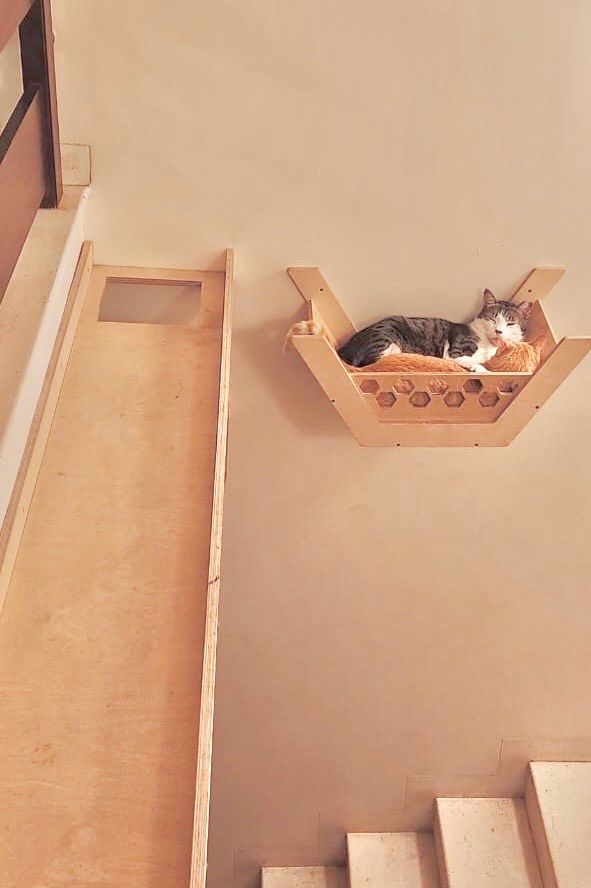
Cats need places where they can retreat and relax without being disturbed. Elevated resting spots and quiet hiding areas help cats feel secure and reduce stress levels.
Predictable Routines
Cats feel safer when life is predictable. Feeding, playtime, and daily interactions should happen at roughly consistent times whenever possible.
Play and Hunting Behavior
Play is not just entertainment — it is a biological need. Regular interactive play helps release tension and provides mental stimulation. Short, frequent play sessions are often more effective than long ones.
Resource Distribution
In multi-cat households especially, resources should be spread out:
- Multiple litter boxes (number of cats + 1)
- Multiple water sources
- Multiple resting spots, low and high
- Multiple feeding areas
This reduces competition and tension.
Litter Box Comfort
The litter box itself is one of the most important resources. Cats may avoid it if:
- It is dirty
- It is too small (the litter box should be about 1.5 times the length of the cat)
- It is covered or tucked into a cabinet for aesthetic reasons
- It is in a busy area
- Another cat blocks access
For many cats, improving the litter box setup alone can significantly reduce house soiling.
Why Indoor Sterilized Cats Are Often Affected
Indoor sterilized cats are especially prone to stress-related urinary issues. They often:
- Move less
- Experience less stimulation
- Have smaller territories
- Face more resource competition
- Have fewer opportunities to express natural behaviors
This combination can increase chronic stress levels, which in turn can trigger bladder inflammation in sensitive cats.
Treating the Cause, Not Just the Symptom
When a cat urinates outside the litter box, it’s tempting to focus only on stopping the behavior. But long-term improvement usually comes from addressing the underlying causes.
This often means:
- Reducing stress
- Improving the environment
- Increasing activity
- Supporting emotional wellbeing
- Treating any medical issues
In many cases, once the cat feels safer and more comfortable, the unwanted behavior resolves naturally.
The Basecamp Rule: The Key to Preventing Stress and Rivalry Between Cats
Always keep the basecamps of cats living in the same home separate. Observe which room each cat naturally spends the most time in, and turn that room into its basecamp with litter box, water, food, toys, and a cat tree by the window. I often see people creating one basecamp for two cats (i.e. putting everything in the same room), and this is one of the main causes of stress and rivalry between cats. If necessary (escalations of territorial rivalry), replace the door with a mesh door so the cats remain separated but can still see each other; over time this helps reduce tension naturally. When the door is open and they are together, you should lead the play—don’t let them decide how to interact. Play with them and offer treats, so they build only positive memories of the time they spend together.
A Different Perspective
House soiling is frustrating, but it’s often a sign that a cat needs support — it doesn’t mean discipline is needed or that the cat should be removed from the home.
Seen this way, inappropriate urination is not a failure — it is communication. And when we listen carefully, we often discover that what the cat needs most is not punishment or restriction, but a better environment and a little more understanding.
Just because the vet ruled out other diseases doesn’t mean the cat is healthy or that FIC isn’t real. Feline Idiopathic Cystitis (FIC) is a genuine condition, diagnosed when all other known causes of bladder problems have been excluded. It is a diagnosis of exclusion, not made up — the cat is really suffering, even if no infection or stones are found.